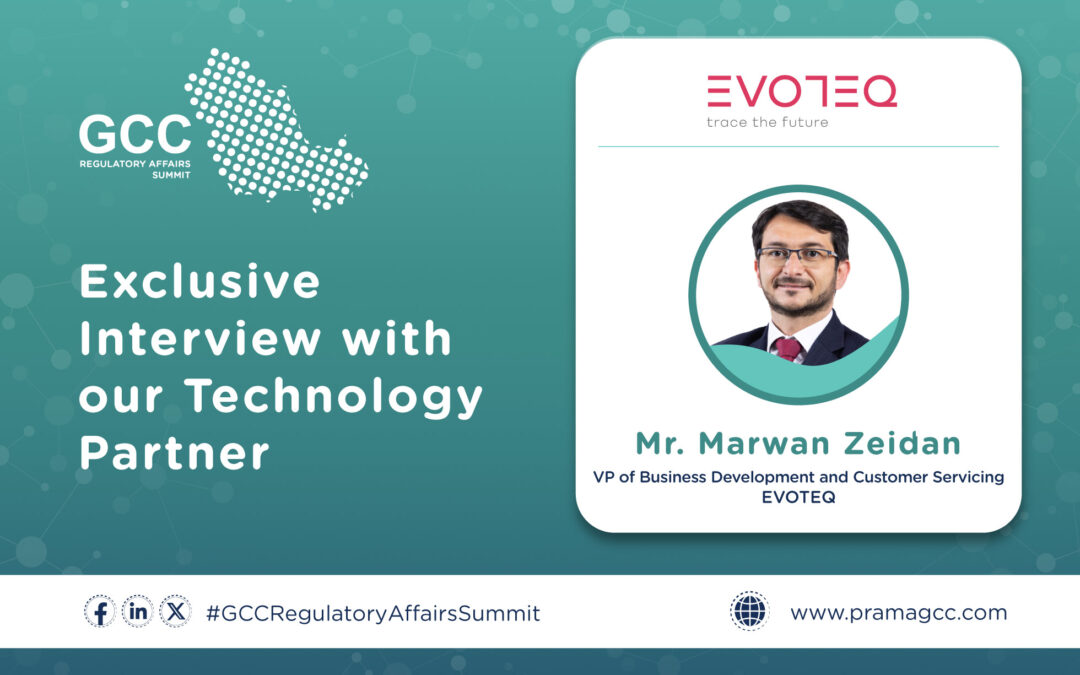
Ahead of the GCC Regulatory Affairs Pharma Summit 2026, Marwan Zeidan, VP of Business Development and Customer Servicing at EVOTEQ, shares insights on how traceability, real-time data, and interoperability can strengthen compliance, supply security, and healthcare resilience across the GCC.
Question 1:
From your experience with national traceability programs, what separates a system that changes behaviour in practice from one that is only compliant on paper?
The honest answer is that technology is the easiest part. Many countries in the region did deploy a traceability platform and ticked the boxes. However, because we are also the investor and operator, we had to make sure our platform has real value and able to adapt and enhance across the years. We have skin in the game as we operate in a public private partnership; we’ve put in the investment and only recuperate on success and value. The recent crisis really put us to the test, and we managed to show stock levels, locations and predictions.
What changes behaviour in practice is when every actor in the chain knows that gaps will be detected. Not eventually, not in an annual audit, in near real time. When a distributor knows that a missing scan will surface as an anomaly within hours, behaviour changes. When a manufacturer knows that a diverted batch will be traced back, behaviour changes.
Question 2:
As serialization matures across the GCC, how can real-time traceability data help regulators and manufacturers do more than fight counterfeits. For example, improve recalls, prevent shortages, and strengthen supply resilience?
Serialization is the foundation and having a traceability platform is the step to follow. There are core use cases such as commissioning, recalls and stock level visibility, and from there the possibilities are endless. We are currently doing predictive analytics leveraging many factors such as historical information, seasonality and trends, to assess stock levels needs and replenishment cycles. From there we are exploring many other use cases that focus on the patient’s well-being and operational optimization, such as linking with insurance and linking with other government entities and systems.
This is why we think of traceability as a resilience infrastructure, not a compliance tool. The GCC has invested heavily in health security, and a national traceability platform is part of that foundation. The data does not just tell you what happened. It tells you what is about to happen.
Question 3:
As AI-enabled traceability expands, what governance issues around interoperability, data ownership, and regulatory oversight should GCC stakeholders address now?
These are questions I think about a lot, and I will be honest, I do not think any of us in the industry have complete answers yet. That is partly what makes this conversation important.
What I can say from our experience is that data sovereignty must be settled early. In every national programme we have been part of, the question of who owns the data, and who can access it under what conditions, needs to be answered before the platform is built, not after. Our position is clear: national health data belongs under national authority. We are the technology layer. We also enable anonymization of data and reports, in order to expand the benefits achieved without having any compromises.
AI is evolving very rapidly, and adoption is increasing exponentially. There is no doubt that the value from AI is quite large and should not be overlooked, but we also need to have the right guard rails and frameworks in place. This is why events such as this one are vital in keeping the dialogue active between regulators, technology providers, and health authorities across the region. These are conversations the GCC needs to be leading, not catching up on.
Question 4:
Different GCC countries are at different stages of national traceability. What would meaningful interoperability across national systems look like in practice, and what is the biggest barrier today?
Meaningful interoperability does not require every country to use the same platform. It requires every platform to be able to exchange data by speaking the same language or at least be able to translate through common terminology. This is where the adoption of global standards organizations like GS1 becomes vital, and enables have trust frameworks that allow one regulator’s verification to be recognised by another, without compromising national sovereignty.
The technology to do this exists today. We have proven it in the UAE, we are building it with DAF and EDA in Egypt, and we are in active conversations across MENA and Africa. The capability is there.
The barrier is not technical. In my experience, the harder challenges are around alignment — each country has invested in its own approach, and bringing those approaches into dialogue takes time and trust. That is not a criticism, it is the natural reality of how national programmes are built. But it is where the industry and regulators need to focus energy now, before the region’s systems become harder to connect.
The GCC has a real opportunity here and a real need as well. Times of crisis usually accelerate the execution, and today we see a real need across the GCC to have a wider visibility and traceability on pharmaceuticals.
Join the Conversation at the GCC Regulatory Affairs Summit
Gain practical insights, engage with regional regulatory authorities, and strengthen your regulatory strategy at the GCC Regulatory Affairs Summit.
Register now: www.pramagcc.com
Be part of the platform shaping the future of regulatory excellence in the GCC.