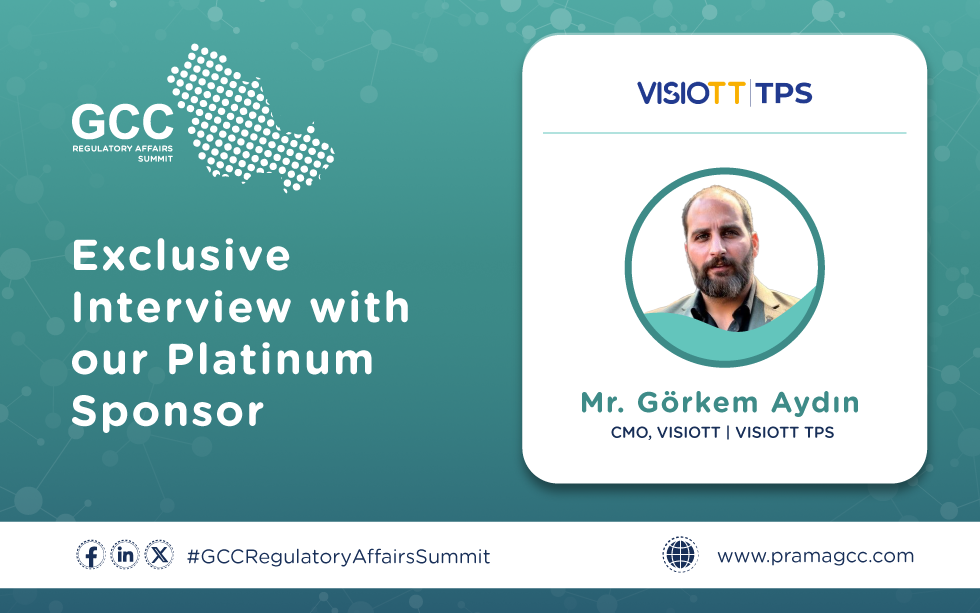
Ahead of the GCC Regulatory Affairs Pharma Summit 2026, Görkem AYDIN, Chief Marketing Officer at VISIOTT Traceable Packaging Solutions, shares expert insights on how evolving track & trace regulations are influencing pharmaceutical serialization, compliance strategies, and supply chain security across the GCC.
Question 1:
Track & trace requirements are evolving rapidly across GCC markets. From your experience, how are regional regulations shaping pharmaceutical serialization and traceability strategies for manufacturers today?
What we observe in real projects is that manufacturers are now being pushed to rethink their traceability architecture as a whole. Instead of implementing country-specific, short-term solutions, there is a growing need for centralized yet flexible systems that can support multiple GCC regulations while remaining aligned with global standards.
This regulatory direction is shaping strategies toward scalable,line-independent architectures and software-driven compliance models. Manufacturers that invest early in adaptable serialization and track & trace infrastructures are finding it much easier to respond to new requirements without disrupting production- while those relying on rigid or fragmented systems face ongoing compliance and operational risks.
Question 2:
Many pharma companies struggle with balancing compliance and operational efficiency. What are the biggest challenges you see organizations facing when implementing end-to-end serialization and track & trace systems in the GCC?
The biggest challenge is not compliance itself, but how compliance is implemented. In many cases, serialization projects are treated as purely regulatory initiatives, without sufficient consideration of production realities, line performance, and long-term system ownership.
We frequently see challenges related to integration, between packaging equipment, site-level software, and enterprise systems. When these layers are not designed as a single ecosystem, companies experience increased manual intervention, data inconsistencies, and avoidable downtime.
Another key issue is future-proofing. GCC regulations are still evolving, and systems that are difficult to scale or reconfigure quickly become a burden. Organizations that succeed are typically those that work with solution partners who understand both regulatory expectations and shop-floor dynamics, and who design systems that protect efficiency while ensuring compliance from day one.
Question 3:
Looking ahead, how do you see digital traceability, real-time data, and smart technologies transforming regulatory oversight and supply chain security for pharmaceuticals in the region?
Digital traceability is fundamentally changing the relationship between regulators, manufacturers, and the supply chain. Real-time and near–real-time data availability enables authorities to move toward more transparent, risk-based oversight models, while manufacturers gain unprecedented visibility into their own operations.
From a technology perspective, serialization data is no longer just a reporting requirement – it is becoming a strategic asset. When properly structured, it supports counterfeit prevention, recall readiness, inventory optimization, and supply chain resilience across the region.
Smart technologies, system interoperability, and analytics-driven monitoring will continue to strengthen supply chain security in the GCC. In this environment, companies that have invested in robust, integrated track & trace platforms will be best positioned, not only to comply with future regulations, but to actively support regulatory goals
around patient safety and market integrity.
Join the Conversation at the GCC Regulatory Affairs Summit
Gain practical insights, engage with regional regulatory authorities, and strengthen your regulatory strategy at the GCC Regulatory Affairs Summit.
Register now: www.pramagcc.com
Be part of the platform shaping the future of regulatory excellence in the GCC.